Nominal capacity
up to 300 m³/day


Growth proposal for farmers and collectives
Bio Cycle Labs — Liquid waste
Industrial recovery, rapid deployment, and direct agronomic benefits for modern cooperatives.
Nominal capacity
up to 300 m³/day
Container footprint
40 ft modular unit
Cost positioning
targeted below common market bands
A shared treatment backbone for multi-site coordination, predictable compliance, and lower per-member operating pressure.
Modular 40 ft format helps teams move from planning to operations quickly, with less infrastructure friction.
Use nutrient-rich outputs directly across member farms to improve soil performance and reduce dependence on external inputs.

Field-use oriented output planning

Designed for high-volume wet streams

Shared capacity across member farms
Our technology has been validated through industrial installations across dairy, food processing, petrochemical, and agrochemical sectors — delivering proven COD reduction, full disinfection, and zero-waste outcomes.
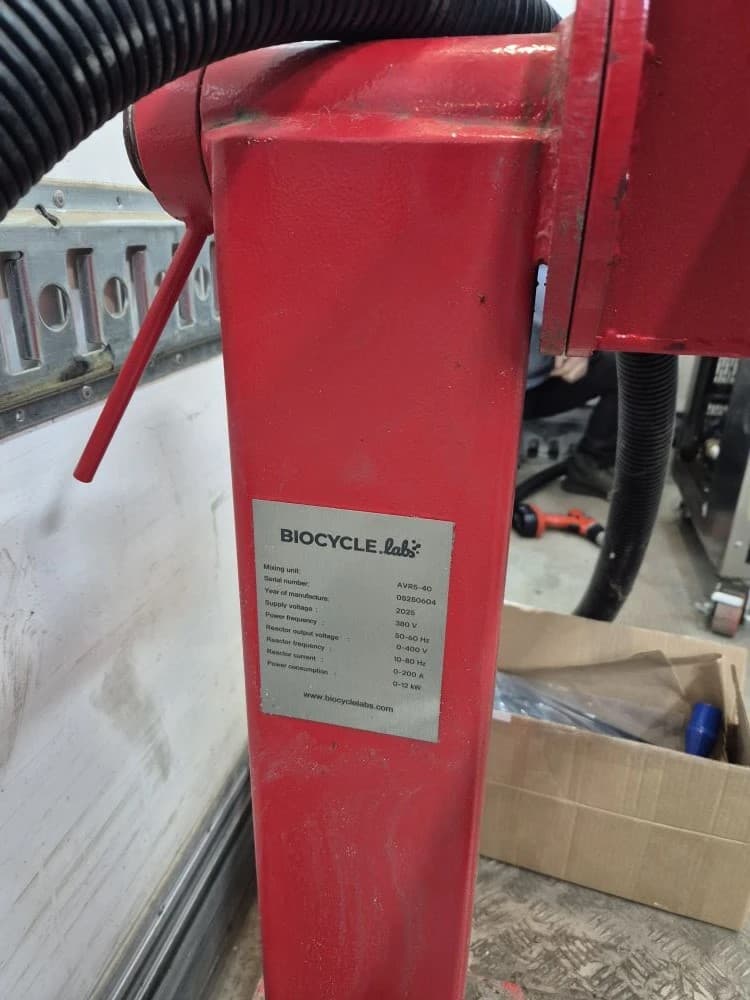
Deployed equipment
VLR activation effects
Mechanical effects
Ferromagnetic bodies moving at extreme velocities and frequencies produce maximum dispersion inside the reactor, fully dissolving all reagents and air mass injected into the liquid. This increases reagent effectiveness by orders of magnitude. The uniform mechanical contact of particles destroys all microbial cell membranes — achieving 99.99% disinfection, far exceeding ozonation or UV sterilization — and completely eliminates odors.
Electromagnetic effects
Collision of ferromagnetic bodies neutralizes positively charged ions that stabilize dissolved suspended matter, accelerating oxidation processes thousands of times over. Neutralized suspended particles precipitate almost instantly. The system decomposes complex chemical compounds and catalyzes the destruction of molecular bonds.
Outcome: Full design, supply, installation, and successful commissioning completed. Final COD reduced to within regulatory limits (below 500).
We return water to the ecosystem.
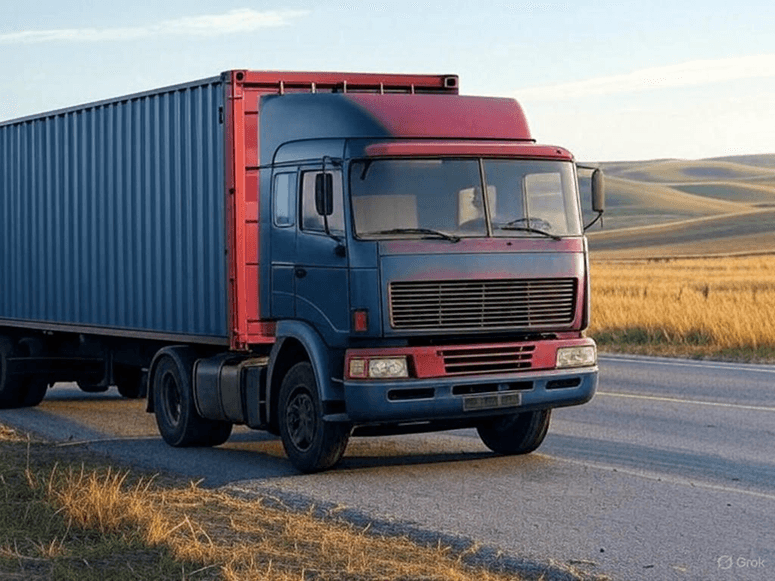
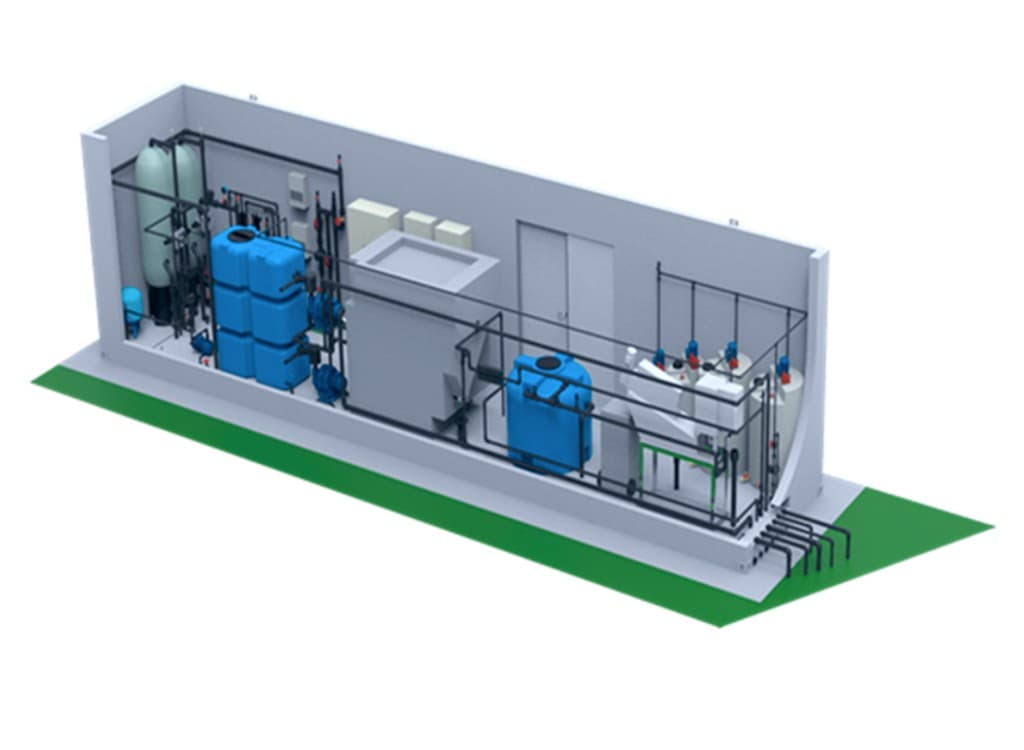
We treat liquid effluents at industrial throughput: a single 40 ft module is designed for up to 300 m³ per day of treatment capacity, depending on feed characteristics and configuration.
Nominal capacity (40 ft unit)
up to 300 m³ / day
We process livestock and utility streams at source: cattle effluent, poultry litter runoff, swine wastewater, sheep/goat streams, domestic wastewater, lagoon legacy waste, and food-processing liquids including whey. A mobile unit can serve multiple farms within one radius while keeping logistics simple.
| Stream type | Treatment outcome |
|---|---|
| Livestock liquid manure | Deactivated and stabilized |
| Poultry/swine streams | Odor removed, sanitised output |
| Lagoon legacy waste | Recovered into useful fractions |
| Domestic wastewater | Prepared for safe reuse pathways |
| Food-processing liquids | Converted into value streams |
Illustrative comparison: internal target band vs. typical market reference range (sources vary by region and contract). Not a guarantee of performance.
€ per m³ treated
| Target treatment cost (project) | < €10 / m³ |
|---|---|
| Reference market cost band | €25–45 / m³ |
| Nominal capacity (40 ft unit) | up to 300 m³ / day |
| Process throughput range (layout-dependent) | 5–50 m³ / h |
| Reference feed (case study) | Whey, food production |
Collective utilisation strategy
The highest-performing collectives do not stop at compliance. They use one treatment backbone to reduce disposal costs, improve on-farm nutrient efficiency, and strengthen member economics season after season.
Start with member farms, nearby processors, and seasonal overflow streams to lock baseline throughput.
Route sanitised nutrient streams into field programs and crop plans where they deliver immediate farm-level value.
Add units across neighboring territories to extend treatment capacity and compound input-cost reduction.
Electrolysis, cavitation, and magnetostriction condition the water for rapid chemical polishing, efficient reagent dissolution, and gas transfer—enabling very fast reaction kinetics. In a 40 ft container layout, throughput can reach roughly 5–50 m³ per hour, depending on configuration and water class.
A new aeration approach supports dissolving more than 80% of the gas into the liquid phase at low energy input, improving mass transfer where it matters.
By combining biochemistry and molecular-scale design, we use a microbial substrate that outperforms common carriers: about 5,000 m² of effective surface area per 1 m³ of media for biofilm development.
This sales-led rollout is designed to shorten time-to-value: first secure throughput, then activate direct farm-use value, then scale by territory.
Week 1-2
Capacity and site mapping for your collective footprint
Week 3-4
Commercial model finalisation: buy, lease, or co-invest
Week 5-8
Engineering prep, permitting support, and delivery scheduling
Week 9-12
Commissioning, operator training, and first direct-use cycles
Export
Stylish PDF decks in your selected language — ready to share with boards, partners, and investors.
PDF · 16:9 · Bio Cycle Labs design system
Choose your commercial model and move to deployment planning immediately. Early commitments receive priority in regional scheduling and engineering onboarding.
Deployment windows are limited. Select your path now and reserve your treatment capacity before your next peak waste cycle.
Buy directly
Acquire the unit as a cooperative asset and keep full control over capacity, margins, and expansion.
Reserve this modelLease
Start fast with lower upfront investment and predictable monthly payments while preserving cash.
Reserve this modelCo-invest as a collective
Split capex across member farms and share treatment throughput plus biofertilizer output.
Reserve this modelBy contacting us you agree to follow-up communication regarding this proposal.